Your Security Awareness Program Assumes a Human Gets It Right. Here Are Four Controls That Don't.

In May 2024, one of the largest health systems in the United States went to paper.
In May 2024, one of the largest health systems in the United States went to paper.
If your organization runs on-premises Active Directory (and most rural health care organizations still do), there is a change coming in April 2026 that could break authentication across your environment if you have not prepared for it. Microsoft is retiring RC4 as the default fallback encryption for Kerberos ticket issuance on domain controllers. For environments that have been quietly relying on this decades-old fallback without realizing it, the April cumulative update will disable it by default.
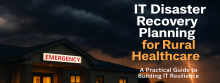
You have been placed in charge of disaster recovery planning at your rural health care facility. Maybe someone told you to "create our DRP." Maybe it landed on your desk because you are the IT person. Or maybe you drew the short straw at the last staff meeting.
Here is what nobody told you: you have just been handed a responsibility that touches every IT system, every compliance requirement, and every department in your organization. And the traditional approaches everyone will point you toward were not built for you.

Here is a question that keeps health care administrators up at night: What happens when the security measures that protected you yesterday stop working today?
This is not a question about technology. It is a question about leadership.
Rural health care organizations face a difficult reality. You have limited IT staff. You have tight budgets. You have employees who get frustrated with security procedures. And you have attackers who know all of this and use it against you.


Reviewed by visuaFUSION Systems Solutions health care IT professionals with experience supporting Critical Access Hospitals and Rural Health Clinics.

A Practical Guide for Rural Health Care Organizations
Covers 45 C.F.R. §§ 164.400-414 (Breach Notification Rule)

While the HIPAA Security Rule does not explicitly mention "software patching" or "updates," the HHS Office for Civil Rights (OCR) has established through enforcement actions that maintaining current, supported software is a required component of HIPAA compliance. The 2014 Anchorage Community Mental Health Services (ACMHS) settlement serves as the definitive precedent, with OCR explicitly citing the failure to apply patches as a Security Rule violation resulting in a $150,000 penalty.

As of October 14, 2025, Microsoft Windows 10 has officially reached its End of Life (EOL). If you're reading this while still running Windows 10, you're already at risk of noncompliance with HIPAA security requirements, and both Microsoft and the Office for Civil Rights (OCR) know it.

Picture this: Your 18-bed critical access hospital just received a HIPAA audit notice. Your IT manager turns pale. Why? Because you've been running on Microsoft 365 Business Premium, thinking you were saving money. What you're about to discover could be the difference between a clean audit and a compliance nightmare that costs your facility millions.
Cookies
This site uses cookies to understand how visitors interact with the site and to improve your experience. You can manage your preferences at any time. Learn more
Cookie Preferences
Choose which categories of cookies you allow. Your preferences are saved for this browser. Privacy Policy
Necessary
Required for the site to function. Stores your cookie preference. Cannot be disabled.
Analytics and Performance
Helps us understand how visitors navigate the site so we can improve it. Data is anonymized and not shared for advertising.
Marketing
Used to deliver relevant advertisements and track campaign performance across platforms.